Protest haiku #1

wooden turkey

Not on the menu,
she stands alone in protest —
a wooden turkey.

#

February might seem a strange time to write a protest haiku about turkey welfare, but Christmas and Thanksgiving aren’t the only times people eat the meat from these birds. As I post this haiku, there are billions of  turkeys undergoing the torture of factory farming. This happens 365 days a year.

Below are some links to “Compassion in World Farming” and “mscpa angell” — organisations which expose the horrors of this industry and look at ways to improve animal welfare.

http://www.ciwf.org.uk/news/turkey_farming/turkey_farming_in_the_uk.aspx

http://www.ciwf.org.uk/news/turkey_farming/christmas_turkeys.aspx

http://www.mspca.org/programs/animal-protection-legislation/animal-welfare/farm-animal-welfare/factory-farming/turkeys/turkeys-on-a-factory-farm.html

For The Love Of Haiku

Don’t poison that mouse!
A rodent fattened on cheese–
Kitty’s dream dessert.

My apologies for skipping last week’s haiku challenge and producing a rather belated one this week, but have had countless musical commitments over Christmas. Anyone else who wants to jump on board at the last moment and join in with the fun, please check out http://allaboutlemon.com/category/haiku-lovers/

Special Christmas greetings and New Year good wishes to adollyciousirony and all her art game players who’ve provided us haiku lovers with so many eccentric, if not surreal images as our writing prompts throughout 2012.

You can check out the making of the image above at http://allaboutlemon.com/art-game/ag-w-21-say-cheese/

Tanka #3: a brief guide to the 31-syllable poetic form

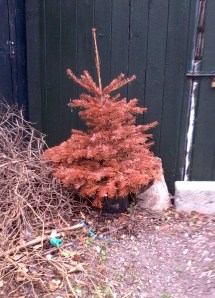
OldChristmasTree

once crowned with a star
it glittered in the firelight
last year’s Christmas tree
dumped forgotten and homeless
its chocolate coins melted

Anyone else out there with a seasonal tanka in them, bursting to get out, if only they understood a little more about this poetic form?

Here are the absolute basics: a tanka is a five-line poem of 31 syllables shared 5-7-5-7-7, so it’s just a longer version of a haiku, which is three lines of 17 syllables shared 5-7-5. Lines 1 and 2 of the tanka usually represent a moment or thought in concrete terms. Line 3 is the pivot. Lines 4 and 5 are your reflection upon that moment or thought.

Sometimes I punctuate my tanka, but the one above called for me to leave it as bare and unadorned as the dead and abandoned tree. There is no hard and fast rule about punctuation.

For more on writing tanka, have a look at http://www.tankaonline.com/Quick%20Start%20Guide.htm

There’s also a comprehensive history of tanka at http://www.tankaonline.com/About%20Tanka%20and%20Its%20History.htm 

Looking forward to seeing your compositions, and please do paste a link to them as a “comment” to this post.

#

And now for something completely unrelated to this post — today I received this message from WordPress:

Happy Anniversary!

You registered on WordPress.com 1 years ago!

Thanks for flying with us. Keep up the good blogging!

#

AND WHAT A YEAR IT HAS BEEN!

A GREAT BIG HUG AND THANK YOU TO ALL MY WONDERFUL BLOGGING FRIENDS 🙂