Love In Ten Lines

Dale, from A Delectable Life, has issued me with a challenge to write a poem about love in ten lines and produce a quote on the same subject. My fault entirely, as I’ve been busy issuing her with challenges over the last few weeks. Apparently I’m responsible for her new addiction to haiku and for her spending an entire morning reading 100-word short stories by Friday Fictioneers, as well as penning a piece of fiction of her own.

The poetry challenge has certain strictures that you can read about below, but first my poem, followed by a quote from my speculative fiction novel, which is presently under the submission microscope.

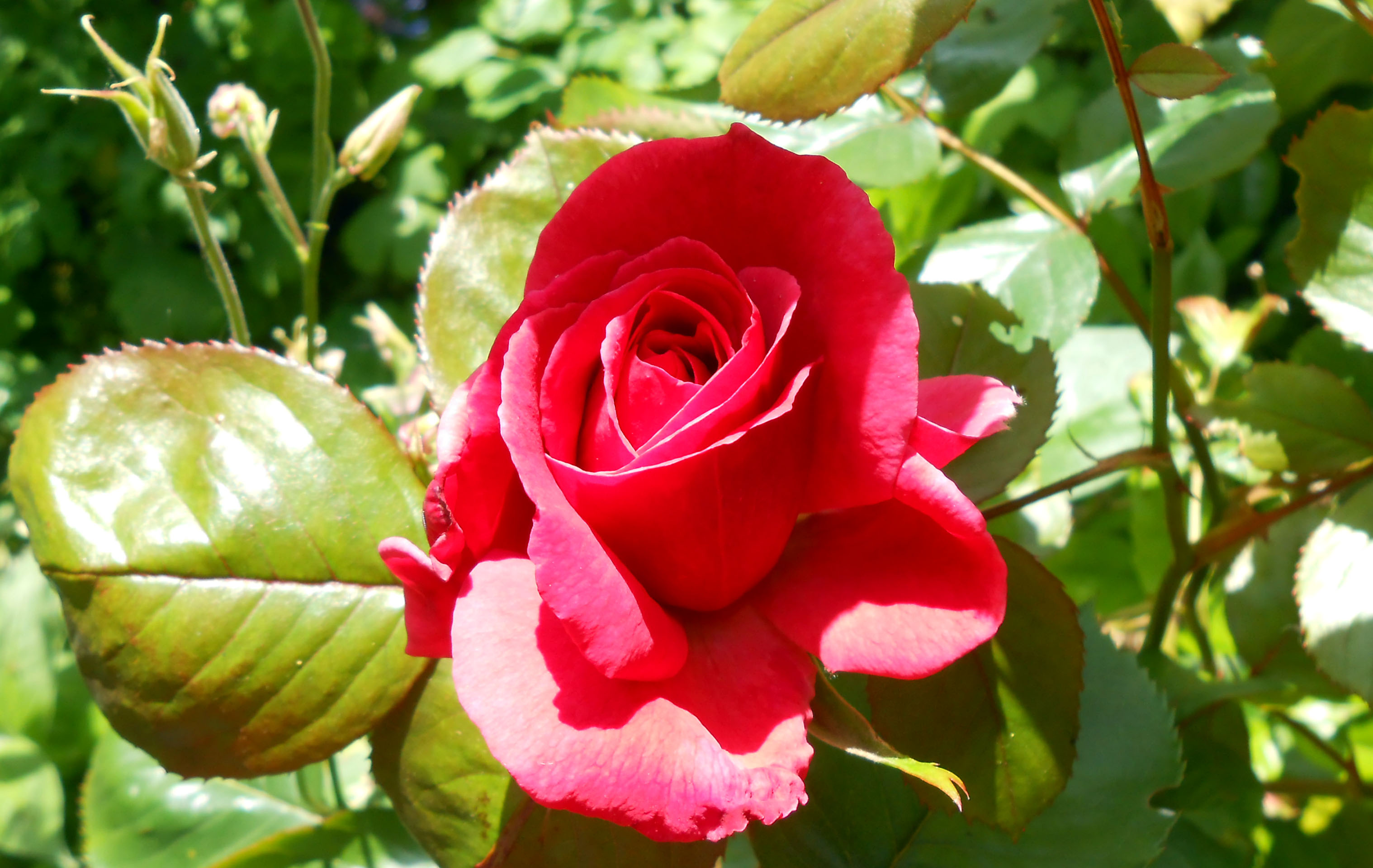
Red Rose 01

The Poem

Shout love from mountaintops
Kayak over love’s waves
Sink into love’s deeps
Drown in impossible love
Passionate love without cure

Love supernovas consuming all
Such love slays commonsense
Insanity becomes love’s bedfellow
Love itself the aphrodisiac
Obstinate love without cure

The Quote
“Life has fractured us both, yet we deserve love.”
— Sarah Potter, Counting Magpies

The Challenge

  • Write about love using only 10 lines.
  • Use the word love in every line.
  • Each line can only be 4 words long.
  • Nominate others who are up for the challenge.
  • Let them know about the challenge.
  • Title the post:  Love in Ten Lines
  • Include a quote about love (this can be your own)
  • You may write in any language

My Nominations*

  1. Sherry at A View From My Summerhouse
  2. Christy at Poetic Parfait
  3. Blondeusk at Blondewritemore
  4. Tokoni at Beautiful Insanity
  5. Leigh at Leigh’s Wordsmithery

[*No obligation to take up the challenge, or time constraints, as that’s not how the poetic Muse works!]

Friday Fictioneers — Wish No More

© Copyright - Rachel Bjerke

Consumed by slime and locked in haze, the forest wore a visage of enchantment. A once-loved spot in dank despair.

The odd array of outbuildings stared, open-mouthed and blank-eyed like a creature forever stunned. Not a peep from the birds, not an animal brave enough to show its whiskers. Even those of lightest claw or paw feared how the waterlogged leaves squidged underfoot and threatened to drag them under.

Then there was the wishing well, its waters a phosphorescent green, unmoving but for the coins tinkling in its depths; or was it the shifting of tiny bones? A child lost.

#

Friday Fictioneers: 100 words stories
Photo Prompt: image © – Rachel Bjerke

Friday Fictioneers — Troll

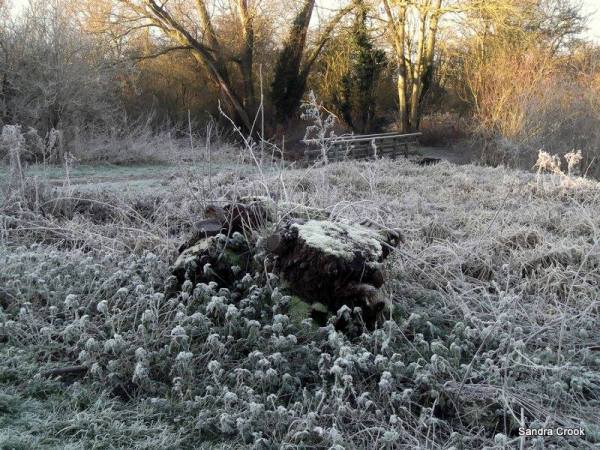
Frost on a stump. Sandra Crook.

The girl stepped out from behind a beech tree, her hair a crest of gold. ‘Over that bridge lies forever-winter.’ Icy breath twirled out of her mouth, although she stood in the sunshine. She pointed towards a frosted glade full of broken stalks, clumped grass, and bedraggled seed-heads, all glazed with frost.

‘It’s in the shade, that’s all,’ I said.

‘I dare you to touch that stump in the middle.’

I crossed the stream and crunched over the white, sure I was heading towards the gnarled remains of an ancient alder tree, until it winked, yawned, and swallowed me whole.

#

Friday Fictioneers: 100 words stories
Photo Prompt: image (c) Sandra Crook

March’s Guest Storyteller, Penny Howe

Penny Howe

Penny’s education/experience is primarily marketing. A serious book lover and reader of books, she says “If I am a true expert at anything, it would be reading books”. A consultant in marketing/writing/editing, her work time is spent alternately between clients and blog writing. She says “I’ve been the person behind the scenes first as a business owner of a marketing/advertising firm and then as a private consultant.” With several books in the works, she will be published in the near future.

The following she wrote for fun. It is for those young at heart who are familiar with Dr. Seuss, his birthday was this week, and of course the famous television series “Dr. Who”. I hope you enjoy.

Blog: www.thewhyaboutthis.com

Horton
Illustration copyright © Nick Holmes

Horton Hears a TARDIS

The day started out simply pleasant.
In fact Horton knew it was great.
His favoritest meal,
the bestest real deal,
was of course a nut full of plates! (actually it’s “a plate full of nuts” but then it wouldn’t rhyme would it. Hello?)

Suddenly, Horton hears a strange sound
and thinks to himself “Oh, no …
not Whoville again?
They just would not send …
in fact, this time I’ll refuse to go.”

It turns out it wasn’t the Whoville
but rather “Dr Who” that arrived.
In his TARDIS he came.
Horton hardly could blame,
the Whovilles for who was inside.

And so Horton looked at the TARDIS
and then, of course, at Dr Who.
He said, “No offense,
and don’t think me dense
but, exactly, Who are you?”

Of course Dr. Who replied, “Brilliant!
What a capital elephant you be,
for though we’ve just met,
you already get,
the person, of course, ‘Who’ is me!”

And Horton looked first at the TARDIS
and once again at Doctor Who.
Still shaking his head,
he wished for his bed,
replied one more time, “Who…are you?”

“Yes I am,” the good doctor responded,
“and most happy to meet you am I.
If you really don’t mind,
and would be so kind,
we must wait for the Daleks to arrive.”

Now Horton, as you know, is a thinker.
Deep thoughts are really his forte,
but Dr Who was a puzzle,
and, in a bit of a fuzzle,
Horton knew not what to say.

And so Dr. Who told him the story,
the Daleks were bad guys, he knew.
Horton told them (Dr. Who and his companions) to stay
and they left the next day (actually it was longer, but that doesn’t rhyme either)
the TARDIS, the Daleks, and Dr. Who.

Well Horton was glad when they vanished
back to whenever they were from.
Now when Horton listens,
he’s not listening for a Who,
but rather the sound of the drums (spoiler).

(you’ve gotta’ watch the TV series to figure the last line out!)

#

Sarah says: Many thanks, Penny, for contributing this most amusing children’s story-in-rhyme to the guest storyteller slot this month. I’m a huge fan of both doctors, Seuss and Who, as are my grown-up offspring and my grandchildren.

It might interest you to know that I’ve watched every episode of Dr Who since its debut screening on British TV on 23rd November, 1963. After the first series, I had to suffer my younger brother walking around in a Dalek costume, threatening to exterminate me!

#

You can find the links to previous guest storyteller posts at https://sarahpotterwrites.com/guest-storytellers-2/

February’s Guest Storyteller, Geoffrey Gudgion

Gudgion-close

Geoffrey Gudgion started writing in warships during the Cold War, and afterwards consistently failed to reconcile writing with a business career. Following a row with his boss he took a career break, wrote Saxon’s Bane (Solaris, 2013), and didn’t go back. His second novel, Catherine Bonnevaux, is now with his agent. His third is “cooking nicely”.

Website & blog: http://geoffreygudgion.com
Facebook: https://www.facebook.com/geoff.gudgion
Facebook Author page: https://www.facebook.com/geoffrey.gudgion.author
Twitter: @geoffreygudgion

The novel in brief — Six hundred years ago, the village of Halgestede was swept away and the Bonnevaux dynasty born with a terrible oath. Today the Halstead Hall estate is crumbling and the Bonnevaux have forgotten the oath, but the oath may not have forgotten the Bonnevaux.

Intro to extract — Most of Saxon’s Bane was in a masculine voice, but the plot for Catherine Bonnevaux challenged Geoffrey to write some tender moments from a distinctly feminine perspective. Here’s a short sample:


CATHERINE BONNEVAUX (Extract)

 “Granny, about…”

“In a moment, darling. Shut your eyes. Tight shut. Let them adjust to the darkness. I’ve something to show you.”

Catherine obeyed, smiling to herself at this child-like complicity. Somewhere nearby a blackbird sang into the gloaming, filling the air with swirling trickles of sound. Faintly, from down in the valley, came the sound of piano music.

“You can open them now. Look around you. See, darling? The daylight stays in the blossom.”

Catherine opened her eyes. Above her, a lattice of branches and blossom screened a sky that darkened to purple in the East, and softened to the West where the Evening Star hung over the hill. Below the horizon the branches were almost invisible against the dark backdrop of the woods. In this near-darkness, the pear blossom appeared to float, unsupported, glowing white as if illuminated from within. Thousands of points of light, dabbed onto the night by a fine-point brush, so they sat within a galaxy of petals that moved almost imperceptibly on the night air.

Strange how you can grow up in a place and not notice something so beautiful, that you can live thirty years without being in this spot, at this time, at this season, with eyes that were not blinded by a torch. Catherine reached for her grandmother’s hand, and squeezed.

“Thank you, Granny.” Her voice caught.

“It’s always best at pear blossom time. There’s more leaf on the trees when the apple blossom bursts.”

“It’s wonderful.” She knew she’d always remember this moment. Her grandmother, birdsong, a distant piano, and blossom, fragrant and pure. A moment of communion that makes all else insignificant.

“I was wooed in this orchard. I was a young nurse, just nineteen. Your grandpa was such a dashing young man, a decorated officer, and yet he brought me out here and showed me the pear blossom at twilight.” Catherine gripped her grandmother’s hand again. As the light faded, the blossom was dimming, so that already it was brightest at the edge of her vision, but the scent remained, cascading its sweetness around them. Catherine felt her hand being lifted and shaken in emphasis. “There are things you wish you’d asked, and there are things I’d like remembered. So when you have children, bring them here, and tell them that your Granny fell in love under this tree.”

Catherine stood, swallowing, and stepped away from the seat, holding out her hand to feel for a branch she knew was there. The bark was coarse and damp, and lichen crumbled under her fingers. At the edge of her vision, a hint of blossom swayed to the movement in the branch. The moon was rising above Brambledown, bathing the valley below in a gentle, monochrome glow. Yellower lights shone in The Old Dairy, silhouetting Fiona in the picture windows. Her outline looked huddled, even at this distance, perhaps folded over her arms, tense. Piano music spilled past her through open French doors, and carried faintly up the hill. Rich, classical music, played loudly and furiously, and too heavy for the moment that she and Granny had just shared.

“Rachmaninoff,” Granny said, coming to stand beside her. “The C Sharp Minor Prelude. Not an easy piece.” They were quiet for a moment, listening, until Granny sighed. “He’s better at Chopin. That’s much too angry.”

Below them, the hunched figure stepped inside, and the music stopped with the shutting of the door.

“Don’t get too fond of him, darling, will you?”

Catherine didn’t answer.

“Only, things are complicated enough already. And I’m getting cold. Where’s that torch?” In an instant, a pool of light beside them turned the night fully black, shrinking the moon glow until only the lights of The Old Dairy were visible beyond the tracery of branches.

#

Sarah says: Geoffrey, thank you so much for your return visit to my blog, this time as a guest storyteller. I love this extract from Catherine Bonnevaux, where you’ve captured with such authenticity and atmosphere that special female intimacy between Catherine and her grandmother. I can’t wait to read the whole novel.

For those who missed Geoffrey first time round you might like to read Interview with Author Geoffrey Gudgion, in which we discuss his first novel Saxon’s Bane, and my review of the book on Goodreads, where I awarded it five stars.